Your Website Never Closes. So Why Is Nobody at the Counter?
Key Takeaways
- Respond to a web lead within an hour and you are about 7× more likely to qualify it — yet the average company takes 42 hours.
- 70% of online carts are abandoned, and many die at a moment of doubt an agent could resolve on the spot.
- 43% of consumers quietly stop buying from a brand after a single poor service experience.
- Customers have moved to messaging: 600 million chats happen between people and businesses every day on WhatsApp, Messenger, and Instagram.
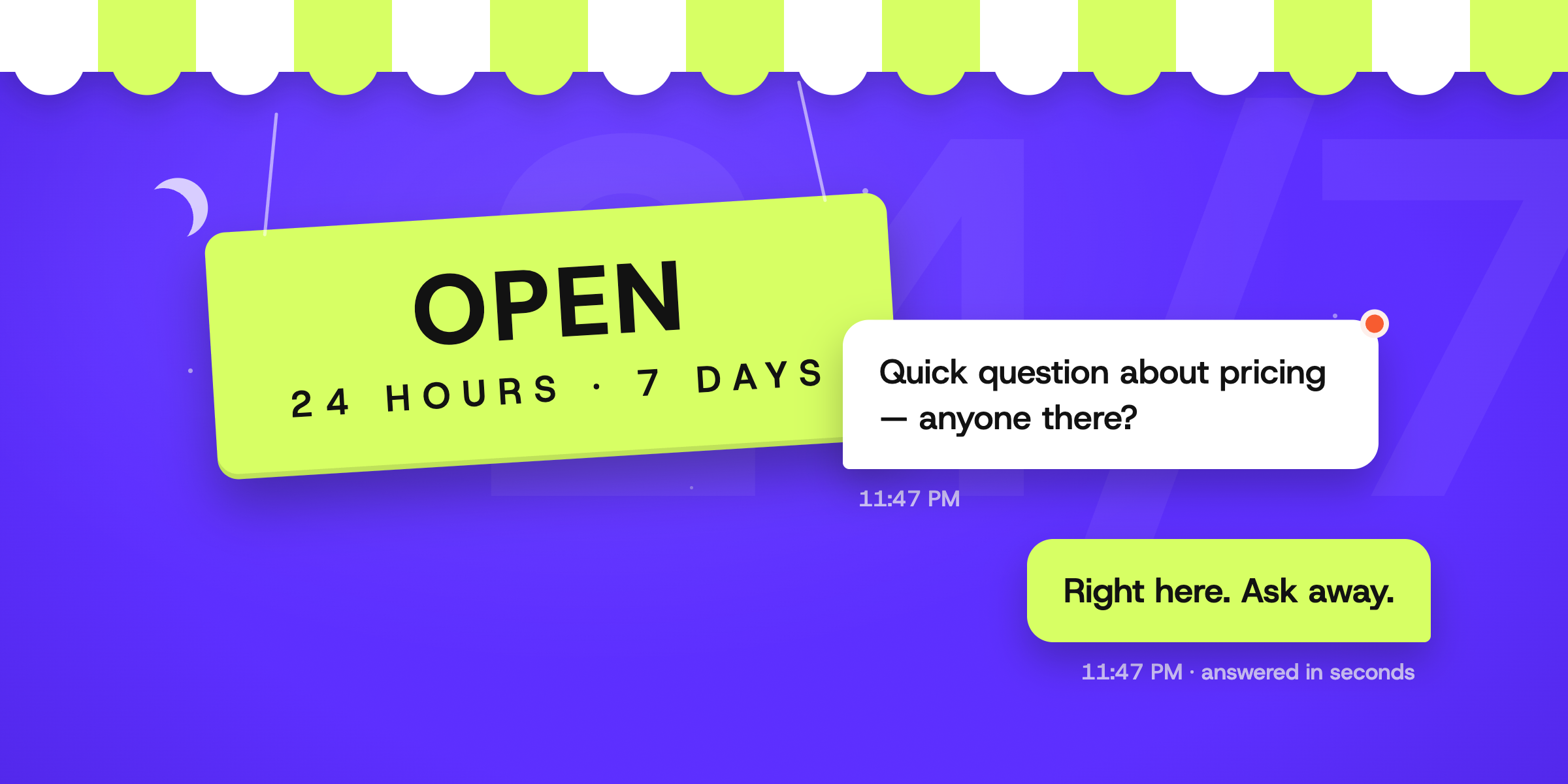
It's 11:47 on a Tuesday night. Someone is on your pricing page.
They have one question. About shipping, or the integration, or whether your plan covers their team size. One question standing between them and a decision. And what does your website offer them?
A contact form. "We'll get back to you within two business days."
By morning, they've moved on. Probably to a competitor whose site answered.
This is the quiet leak in almost every digital business. It never shows up as a line item, because you can't measure the customers who left before you knew they existed. But we can get close, and the numbers are hard to look at.
The most expensive hour in your funnel
Here's what happens right after someone raises their hand on your website. Harvard Business Review audited 2,241 U.S. companies, sending each one a web lead and timing the response. Companies that replied within an hour were about seven times more likely to qualify that lead.
The average response time? 42 hours. Nearly a quarter of companies never responded at all.

Read that again. One in four businesses paid to generate a lead, received it, and then said nothing. Forever.
And the window is tighter than an hour. The research behind the famous "5-minute rule" found that waiting 30 minutes instead of 5 makes you 21× less likely to qualify a lead. Leads don't cool off. They evaporate.
No sales team on earth responds in five minutes at midnight. An AI agent responds in five seconds, at 2 pm and at 2 am, on a Tuesday and on Diwali.
You've met the old chatbots. This isn't that.
Fair warning: if the word "chatbot" makes you wince, you're remembering the right thing. Those rigid decision trees that understood five phrases and escalated everything else did real damage to the category.
AI agents are a different species. An agent speaks plain language and answers from your content: your docs, your catalog, your policies. More importantly, it does things: qualifies the lead, books the demo, tracks the order, opens the ticket. And when a human should take over, it hands off the whole conversation, context intact.
If that sounds like optimistic vendor talk, consider that Gartner, not a firm known for hype, expects agentic AI to autonomously resolve 80% of common customer service issues by 2029, cutting service operating costs by around 30% along the way.

Carts don't abandon themselves
Support tickets are the visible leak. The quieter one is sitting in your checkout.
Across 50 studies tracked by the Baymard Institute, the average online cart abandonment rate sits at 70%. Seven in ten shoppers get all the way to a cart, then walk.
Some of them were never going to buy. But a lot of carts die at a moment of doubt. A size chart that doesn't quite answer the question. A shipping cost that appears without explanation. A returns policy buried three clicks deep. Small doubts, arriving at exactly the moment your customer is deciding, with nobody there to resolve them.
An agent that answers in that moment is the cheapest conversion work you will ever ship. No redesign. No new checkout flow. Just someone finally at the counter.
Your customers didn't stop talking. They changed rooms.
While most businesses were polishing their websites, their customers moved into messaging apps. People and businesses now exchange 600 million chats every day across WhatsApp, Messenger, and Instagram.
That's not a trend to watch. That's where your customers already are: asking questions, comparing options, expecting answers in the same thread where they talk to friends. A business that only answers on its website is a shop that only answers the front door while the whole neighborhood texts.
And expectations moved with them. When Salesforce surveyed 15,015 consumers, the picture was blunt:

The one that should keep you up at night: 43% of consumers stop buying from a brand after a poor service experience. Not complain. Not tweet. Just quietly leave. Meanwhile, 37% of Gen Z and millennials say they'd rather deal with an AI agent if it means faster service. The customers you'll be serving for the next two decades have already picked a side.
The upside is bigger than the defense
So far this has been about leaks. But the teams adopting agents early aren't just plugging holes. They're compounding. McKinsey puts the productivity lift from generative AI in customer care at 30 to 45 percent. At one 5,000-agent company they studied, AI assistance meant 14% more issues resolved per hour, with the biggest gains going to the newest team members.
The same trick works facing inward. Point an agent at your HR policies, IT runbooks, and product docs, and it becomes the colleague who has actually read the wiki. Your team stops interrupting each other for answers that were written down two years ago.
The catch: customers punish AI done badly
The same research that shows customers embracing AI shows them walking away from the sloppy kind. The difference isn't intelligence. It's manners.
A good agent answers from your content, never from imagination. It's upfront about being AI. Three-quarters of customers want to know, so tell them. It knows when to step aside: people are 45% more likely to use an agent that hands a conversation to a human cleanly, context and all. It gives the same answer on your website, on WhatsApp, everywhere. That's the consistency 69% of customers now expect. And it works where you can see it, so you always know what people asked and where it needs to get better.
Miss on these, and you've built a faster way to disappoint people. Get them right, and the agent quietly becomes the best hire you never made.
Which brings us to why we built TheenkAI
Everything above is the gap we kept seeing: good businesses losing conversations they never knew they were having. We built TheenkAI to close it, without the six-month AI project.
It works the way you'd hope. Point TheenkAI at what you already have: your site, your docs, your FAQs. You get an agent that answers the way you would. A single snippet puts it on your website. Connect your WhatsApp number and it's there too; same for Messenger, and SMS or voice through Twilio. One agent, one set of answers, every room your customers are in. And when a conversation needs a human, it hands over gracefully, transcript and analytics in full view, because an agent you can't inspect is an agent you can't trust.
Your website already never closes.
Now someone's always at the counter.
Get early access at theenk.ai →
Data referenced throughout: Gartner (2025), Harvard Business Review (2011), Baymard Institute, Meta (2023), Salesforce State of the AI Connected Customer (2024), McKinsey (2023). Links inline.

TheenkAI Team
The team building TheenkAI — AI agents that answer from your content, act across your channels, and hand off to humans gracefully.
Get Started with Theenk.AI 🚀
Open your account today and experience the power of AI chatbots built to grow your business.
Start your 14-day trial